
What materials are commonly used in hdi pcbs?
materials are commonly used in hdi pcbs
The development of a circuit board requires many steps to create a product that meets your design requirements. The design process is the first step, utilizing CAD and CAM software to develop a schematic of your board. This will show how your components connect and what they do. The schematic is then translated into a PCB layout that will be used to make the actual PCB. The layout must follow specific rules to ensure that impedance requirements and conductor widths are met. The next step is to select the right materials for the board. These include the dielectrics, copper plating, surface finishes and solder mask. Each of these materials can influence the performance and durability of your final product.
A key component of hdi pcbs are microvias, or small holes with a diameter less than 150 microns. They are most commonly laser-drilled to create a precise hole that is capable of connecting one layer to the next. These tiny vias allow for a much denser design that enables new and more advanced features.
Microvias are also often placed in a staggered pattern for optimal routing. In addition to these structural benefits, they can help reduce the amount of solder needed to connect the board’s components. This can save time and money during the assembly process. For a high-speed, RF or digital circuit board, proper material selection is critical to ensure the best possible signal integrity and performance. Using a low-loss, high-speed material will help reduce crosstalk and signal attenuation in the circuit. In the case of a high-speed digital design, choosing a material with the lowest possible Dk and Df will provide optimum signal transmission performance.
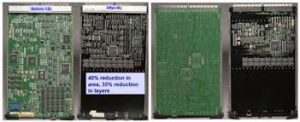
What materials are commonly used in hdi pcbs?
Conductors in HDI circuit boards are typically made of either copper or gold. The standard copper is plated with an organic solderability preservative to prevent oxidation, which can occur in the tight spaces of the small microvias. Alternatively, gold can be used for its superior conductivity and resistance to corrosion. When selecting the right material for your circuit board, you should work with an experienced fabricator that has a proven track record of providing high-quality products.
Other important materials for HDI PCBs are the dielectrics. There are several options available, including optimized liquid epoxy, FR4 glass, silkscreen, and other dielectrics. The type of dielectric selected will affect the thermal and electrical properties of the board, and can be determined by working with a PCB supplier that offers a free material selector tool.
The number of sequential laminations is another important factor in determining the performance of your HDI circuit board. A higher number of layers can increase the rigidity and reliability of the finished product. In addition, the number of via structure types will affect manufacturing time and cost. In some cases, it may be necessary to use a Via-in-Pad process. This is a multi-step process that involves plating the via, filling it with one of several via fill types, capping and then depositing a surface finish.