
What are the components typically found on a circuit board?
components typically found on a circuit board
Circuit boards, or printed circuit boards (PCBs), are made up of a variety of electronic components that work together to perform specific functions. These components are essential for the operation of almost all electronic devices, from smartphones to industrial machinery. Understanding the components typically found on a circuit board provides insight into how electronic devices function and how different elements contribute to the overall design.
One of the most common components on a circuit board is the resistor. Resistors control the flow of electrical current by providing resistance, which limits the amount of current that can pass through a circuit. They are used to protect sensitive components from being damaged by excessive current and to control voltage levels within a circuit. Resistors are typically small cylindrical or rectangular objects with color-coded bands that indicate their resistance value, measured in ohms (Ω).
Another key component is the capacitor, which stores and releases electrical energy in the form of an electric charge. Capacitors are used in circuits to smooth out fluctuations in voltage, filter signals, or store energy for later use. There are different types of capacitors, including electrolytic, ceramic, and tantalum capacitors, each with its own specific purpose. Capacitors are usually cylindrical or rectangular and are marked with their capacitance value, measured in farads (F).
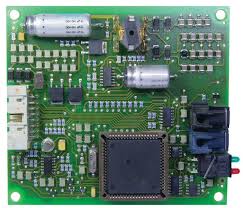
What are the components typically found on a circuit board?
Diodes are also commonly found on circuit boards. A diode is a semiconductor device that allows current to flow in only one direction, acting as a one-way valve for electricity. This property makes diodes useful for preventing reverse currents that could damage other components. One specific type of diode, the light-emitting diode (LED), is widely used for display and indicator lights on electronic devices. Diodes are typically marked with a triangle and a line symbol on circuit diagrams, indicating the direction of current flow.
Transistors are crucial components in modern electronics and are found on nearly every circuit board. A transistor can amplify electrical signals or act as a switch, turning currents on and off in a circuit. Transistors are the building blocks of complex electronic devices, such as computers and smartphones, where they are used to process and transmit signals. There are two main types of transistors: bipolar junction transistors (BJTs) and field-effect transistors (FETs), both of which play critical roles in controlling voltage and current in circuits.
Another essential component is the integrated circuit (IC), which is a small chip that contains a collection of interconnected transistors, resistors, capacitors, and other elements. ICs can perform complex tasks such as signal processing, amplification, and data storage. Common examples of ICs include microprocessors and memory chips. These tiny chips are the brains of most electronic devices and are responsible for executing tasks that enable a device to function. ICs are often mounted on the circuit board using surface-mount technology (SMT), allowing for compact, efficient designs.