
How long does it take to learn paddle boarding?
Take to learn paddle boarding
To get the hang of Paddle board, you first need to learn how to balance on the board. This can take some time, and is best done on a calm lake in the morning or evening when the wind is low. The key to balance is to pick a focal point straight ahead, and stay there. This will help you to focus your energy and attention into the task at hand, rather than staring down at the water lapping beneath you.
Start by positioning your feet shoulder-width apart on the center of the board, parallel and flat against the deck. Then, bend your knees slightly to absorb any shift in movement. Next, place your hands on the paddle shaft. Your left hand should be on top of the grip and your right hand a few inches down on the shaft.
The basic strokes include the forward stroke, which is also called the sweep stroke. This will let you move forward in a straight line, or turn your board by putting the paddle into the water on one side of your body to make a wide arc towards the nose of your board and then pulling back with your arms. The reverse sweep is used to slow down or stop your board by reaching behind you with the paddle blade near the tail of the board and pulling it slowly toward the nose. This technique spins the board on an axis and can be used to make tight turns in small spaces.
If you are new to a sport, it’s important to practice on a regular basis and take lessons from an experienced instructor. Taking a lesson will ensure that you are learning the proper techniques and safety skills, as well as starting off on the right foot. You will also have the opportunity to try out different boards and determine what type of board is right for you.
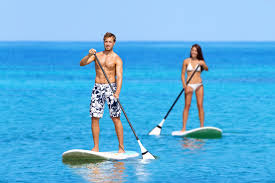
How long does it take to learn paddle boarding?
Don’t be discouraged if you fall off a few times — even experienced paddlers have to wipe out from time to time. But don’t let this deter you from continuing to practice and eventually becoming comfortable enough to stand up on your board. Paddleboarding requires balance, coordination, and a sense of timing. The rider must remain standing on the board, balancing on the water while simultaneously paddling. Many first-timers find it challenging to balance at first, but with practice, it becomes easier. To maintain balance, the rider must adjust their stance on the board, using the paddle to help stabilize their position.
Once you are comfortable standing on your board, it’s time to start working on more advanced skills, such as turning and maneuvering in choppy water. All you need is the right equipment (a paddleboard made for beginners, a leash and a life jacket), a good attitude, and a willingness to learn. And remember to have fun!
As the name suggests, all-around paddleboards are versatile and can be used in various water conditions. These boards are typically larger, wider, and more stable than other types, making them ideal for beginners. They can be used in flat water, as well as light surf, and are suitable for both paddling and some light recreational activities like yoga or fishing.