
Can you explain the importance of fiducial marks in Fast turn pcb assembly?
importance of fiducial marks in Fast turn pcb assembly
Fiducial marks play a crucial role in fast-turn PCB assembly, serving as reference points for accurate alignment and placement of components during the manufacturing process. These small, precisely located marks are typically etched onto the PCB surface using a laser or printed onto the solder mask. While seemingly insignificant, fiducial marks are instrumental in ensuring the precision and reliability of PCB assembly, particularly in high-speed, automated production environments.
One of the primary functions of fiducial marks is to facilitate precise registration of the PCB with assembly equipment such as pick-and-place machines and stencil printers. These machines rely on fiducial marks to determine the exact position and orientation of the PCB relative to the assembly process. By aligning the fiducial marks with corresponding reference points on the assembly equipment, manufacturers can ensure that components are placed accurately and solder paste is deposited precisely onto the PCB pads.
Moreover, fiducial marks aid in compensating for potential distortions or variations in the fast turn pcb assembly fabrication process. During PCB manufacturing, factors such as thermal expansion, material shrinkage, and registration errors can introduce slight deviations in the dimensions and alignment of the PCB. Fiducial marks provide a consistent reference frame for calibrating assembly equipment and compensating for these deviations, ensuring that components are placed with micron-level accuracy and solder paste is deposited in the correct locations.
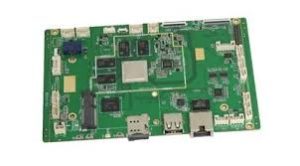
Can you explain the importance of fiducial marks in Fast turn pcb assembly?
Furthermore, fiducial marks enable efficient and reliable machine vision-based inspection of PCB assemblies. Automated optical inspection (AOI) and automated X-ray inspection (AXI) systems rely on fiducial marks to precisely locate and inspect components, solder joints, and other features on the PCB. By accurately registering the inspection system with the PCB using fiducial marks, manufacturers can detect defects, such as misaligned components or insufficient solder, with exceptional speed and accuracy, ensuring the quality and reliability of the final product.
Additionally, fiducial marks play a crucial role in ensuring consistency and repeatability in fast-turn PCB assembly. In high-volume production environments, where time is of the essence, maintaining consistent alignment and placement of components is essential for meeting tight production schedules and quality standards. Fiducial marks provide a reliable reference frame for achieving consistent results across multiple production runs, minimizing variability and ensuring uniformity in assembly processes.
Moreover, fiducial marks facilitate seamless communication and collaboration between different stakeholders in the PCB manufacturing process. Designers, fabricators, assemblers, and testers rely on fiducial marks as common reference points for verifying design intent, assessing manufacturing tolerances, and troubleshooting assembly issues. By incorporating fiducial marks into the PCB design, manufacturers can streamline communication and ensure alignment of expectations throughout the entire manufacturing lifecycle.
In conclusion, fiducial marks play a critical role in fast-turn PCB assembly by enabling precise alignment, compensating for fabrication variations, facilitating automated inspection, ensuring consistency, and fostering collaboration among stakeholders. These seemingly simple marks serve as indispensable tools for achieving accuracy, efficiency, and reliability in the assembly process, ultimately contributing to the success of fast-paced electronics manufacturing operations. As such, the importance of fiducial marks cannot be overstated in the quest for high-quality, high-speed PCB assembly.